
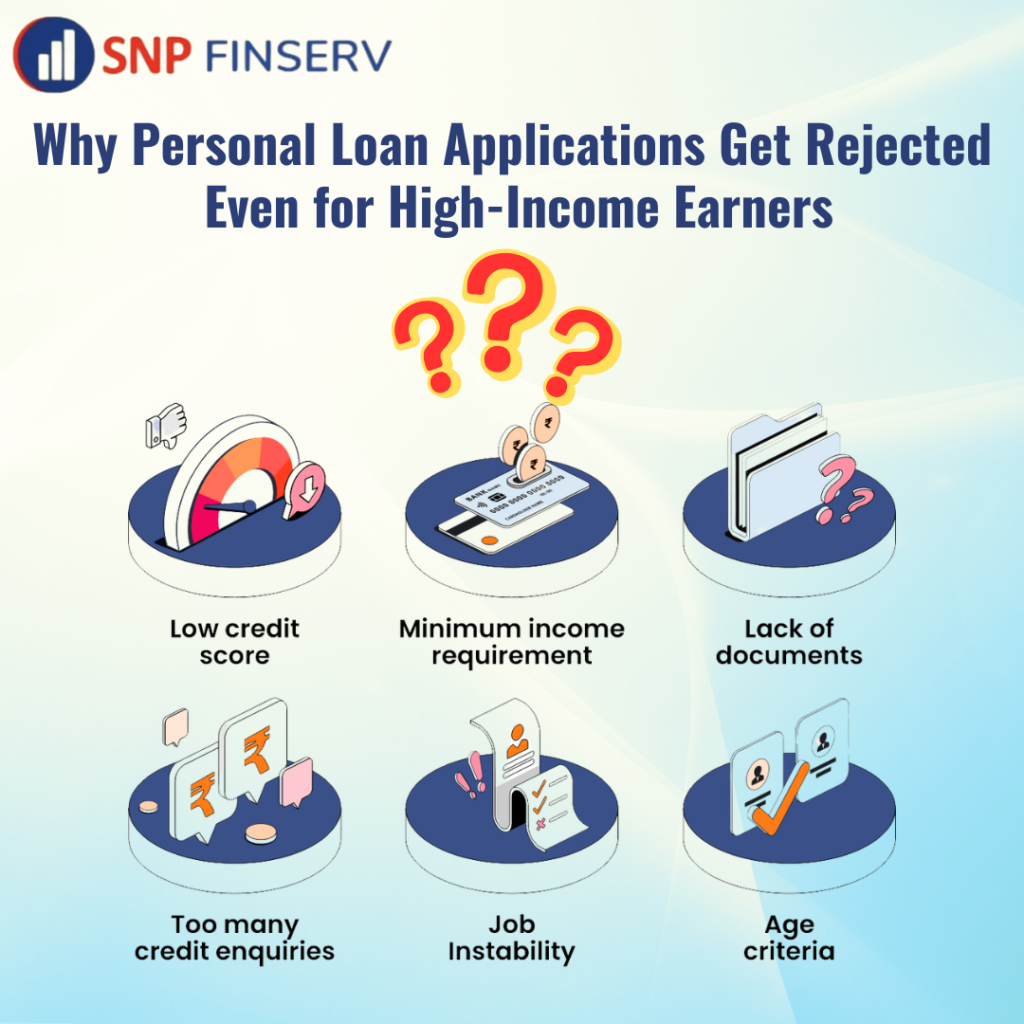
Why Personal Loan Applications Get Rejected Even for High-Income Earners
Many professionals believe that earning a high salary guarantees quick personal loan approval. Yet banks frequently reject personal loan applications of high-income individuals—often without giving a clear reason.
So what really goes on behind the scenes?
The truth is simple: income alone does not define creditworthiness. Banks evaluate risk using multiple parameters, and a strong salary can be outweighed by other negative factors.
Let’s break down the key reasons why personal loans get rejected despite a high income.
- Credit Score Is More Important Than Salary
Your credit score is the first and most critical checkpoint.
Banks use it to assess:
Repayment discipline
Credit behavior over time
Risk of default
A high-income applicant may still face rejection if:
Credit score is below 700–750
There are late payments, settlements, or past defaults
Credit history is short or inconsistent
🔑 Key Insight:
Banks trust repayment history more than income potential.
- High Income but Poor FOIR (Debt Burden)
Banks calculate FOIR (Fixed Obligation to Income Ratio) to see how much of your income is already committed.
If you are paying EMIs for:
Home loan
Car loan
Credit cards
Personal loans or BNPL
…your disposable income reduces significantly.
Most lenders prefer FOIR below 40–50%.
Even a high salary cannot offset excessive existing liabilities.
- Too Many Active Loans or Credit Cards
Holding multiple credit lines increases perceived risk.
Red flags include:
Several active personal loans
Too many credit cards
Frequent loan top-ups
Banks worry about over-leveraging and financial stress during emergencies.
- Multiple Recent Credit Enquiries
Applying to many lenders in a short period negatively impacts approval chances.
Each application creates a hard enquiry on your credit report.
Too many enquiries signal:
Credit dependency
Possible financial distress
Even high-income applicants get rejected due to aggressive loan shopping.
- Job Stability and Employer Risk
Banks assess income stability, not just income size.
Common rejection reasons:
Less than 6–12 months in current job
Frequent job changes
Employment in high-risk sectors
Employer not on lender’s approved list
For self-employed applicants:
Irregular income
High expenses
Inconsistent ITR filings
- Variable Income Is Discounted
If a large part of your income comes from:
Bonuses
Commissions
Incentives
Banks may not fully consider it.
Most lenders calculate eligibility based on fixed monthly income only, as variable income is unpredictable.
- Age and Loan Tenure Mismatch
Age plays a silent but important role.
Younger applicants may lack credit history
Older applicants may face tenure restrictions
Banks want assurance that income will continue throughout the loan period.
- Negative Internal Bank History
Sometimes rejection is due to internal records, not visible credit data.
Possible reasons:
Past settlement with the same bank
Overdue credit card within the bank group
Internal blacklist
These factors may not appear on your credit report but still impact approval.
- Documentation Errors or Data Mismatch
Minor inconsistencies can lead to rejection, such as:
PAN–Aadhaar mismatch
Address differences across documents
Incorrect income details
Employer verification failure
For unsecured loans, data accuracy is critical.
- Bank’s Internal Risk Policy Changes
At times, rejection has nothing to do with the applicant.
Banks may temporarily tighten lending due to:
Economic conditions
Industry-specific risk
Geographic or pin-code risk
Portfolio exposure limits
These policies are internal and change frequently.
Final Thoughts
A high income improves your chances—but does not guarantee personal loan approval.
Banks focus on:
Credit discipline
Repayment capacity
Stability of income
Risk predictability
📌 Think like a lender:
“Will this borrower repay consistently—even if things go wrong?”
How High-Income Earners Can Improve Loan Approval Chances
Maintain a credit score above 750
Keep FOIR under control
Avoid multiple loan applications
Build long-term credit history
Maintain stable employment
Apply with banks where you already have an account