
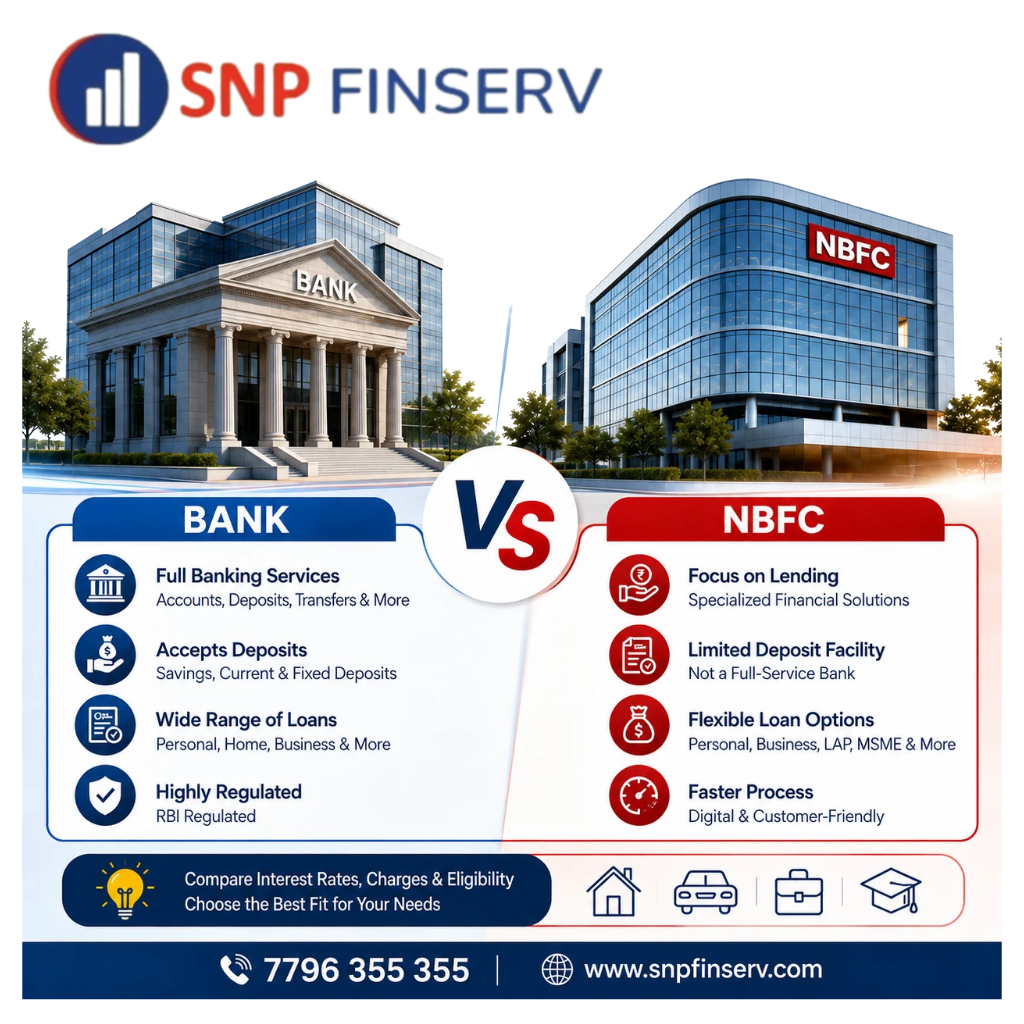
What Is the Difference Between a Bank and NBFC?
When you need financial assistance, you may consider applying for a loan from a bank or NBFC (Non-Banking Financial Company). Both banks and NBFCs provide various financial products and loan services, but their operations, services, and regulatory frameworks are different.
Understanding the difference between a bank and NBFC can help you make a better financial decision based on your loan requirement, eligibility, interest rate, documentation, and repayment capacity.
What Is a Bank?
A bank is a financial institution that provides banking and financial services to individuals, businesses, and other customers.
Banks provide a wide range of financial services, including:
- Savings accounts
- Current accounts
- Fixed deposits
- Recurring deposits
- Personal loans
- Home loans
- Business loans
- Education loans
- Vehicle loans
- Credit cards
- Online banking
- Money transfer services
One of the key features of banks is that they can accept demand deposits, such as savings and current account deposits, subject to applicable regulations.
What Is an NBFC?
NBFC stands for Non-Banking Financial Company. An NBFC provides various financial and lending services similar to banks but operates under a different regulatory framework.
NBFCs may offer financial products such as:
- Personal loans
- Business loans
- Home loans
- Vehicle loans
- Loan Against Property
- MSME loans
- Equipment finance
- Commercial vehicle finance
- Other specialized financial solutions
NBFCs play an important role in providing credit to individuals, self-employed professionals, small businesses, and other borrowers.
Difference Between Bank and NBFC
Although both banks and NBFCs can provide loans, there are several important differences between them.
1. Banking Services
Banks provide comprehensive banking services such as:
- Savings accounts
- Current accounts
- Deposit facilities
- Payment and money transfer services
- Loans and credit facilities
NBFCs, on the other hand, primarily focus on lending and other financial services. They do not operate as full-service banks.
2. Deposit Facilities
Banks can accept demand deposits such as savings and current account deposits.
Most NBFCs cannot accept demand deposits like banks. Eligible deposit-taking NBFCs may accept certain deposits subject to applicable regulations.
Therefore, deposit-taking facilities are an important point when comparing banks and NBFCs.
3. Loan Services
Both banks and NBFCs can offer different types of loans depending on their products and regulatory permissions.
Common loan options include:
- Personal Loan
- Home Loan
- Business Loan
- Vehicle Loan
- Loan Against Property
- MSME Loan
- Equipment Finance
The availability of a particular loan depends on the lender and the borrower’s eligibility.
Bank vs NBFC Loan Eligibility
Loan eligibility depends on the lender’s policies and the applicant’s financial profile.
Factors That May Affect Loan Eligibility
Lenders may consider:
- Age
- Monthly income
- Employment status
- Business profile
- Credit score
- Existing loans and liabilities
- Income stability
- Repayment capacity
- Loan amount required
- Loan tenure
Some NBFCs may offer specialized loan products designed for different customer profiles.
However, loan approval is never guaranteed and depends on the lender’s assessment.
Bank and NBFC Interest Rates
The interest rate on a bank or NBFC loan can vary depending on several factors.
These may include:
- Credit score
- Income
- Loan amount
- Loan tenure
- Type of loan
- Employment or business profile
- Existing financial obligations
- Lender’s policies
Borrowers should compare the applicable interest rate along with processing fees and other charges rather than choosing a loan based only on the advertised interest rate.
Bank and NBFC Loan Documentation
The documents required for a loan depend on the lender, loan type, and applicant’s profile.
Common Loan Documents
Depending on the loan, lenders may request:
- PAN Card
- Aadhaar Card or other identity proof
- Address proof
- Bank statements
- Salary slips
- Income Tax Returns
- Business and financial documents
- Property documents for secured loans
Providing accurate and complete documentation can help make the loan application process smoother.
Loan Processing: Bank vs NBFC
Banks may follow detailed verification and approval procedures before processing a loan application.
Some NBFCs use digital application and documentation processes, which may make the application process more convenient.
However, loan processing time varies depending on:
- Lender
- Loan type
- Applicant’s profile
- Documentation
- Verification requirements
Faster processing does not necessarily mean guaranteed loan approval.
Bank vs NBFC – Which Is Better for a Loan?
There is no single answer to whether a bank or NBFC is better for a loan.
The right choice depends on your financial requirements, eligibility, credit profile, and repayment capacity.
Before choosing a lender, consider the following factors:
Interest Rate
Compare the applicable interest rate and understand whether it is fixed or floating, where applicable.
Loan Amount
Check whether the lender can provide the amount you require based on your eligibility.
EMI
Make sure the monthly EMI is affordable and fits comfortably within your budget.
Processing Fees and Other Charges
Check processing fees, documentation charges, prepayment or foreclosure charges, and other applicable costs.
Loan Tenure
Choose a repayment tenure that balances affordable EMIs with the overall cost of borrowing.
Eligibility Criteria
Understand the lender’s income, credit score, employment, business, and other eligibility requirements.
Documentation
Check which documents are required before submitting your application.
Total Loan Cost
Do not compare loans based only on EMI. Consider the total repayment amount, interest, fees, and other applicable charges.
Why Should You Compare Bank and NBFC Loans?
Comparing different bank and NBFC loan options before applying can help you:
- Understand available financing options
- Compare interest rates
- Compare processing fees and other charges
- Find a loan suitable for your eligibility
- Choose a suitable loan tenure
- Plan your monthly EMI
- Understand documentation requirements
- Evaluate repayment terms
- Avoid unnecessary borrowing costs
- Make a more informed financial decision
How SNP Finserv Can Help With Loan Requirements
Choosing between a bank loan and an NBFC loan can sometimes be confusing. SNP Finserv can help customers understand available financing options and the basic requirements involved in the loan process.
SNP Finserv Can Assist With:
- Understanding different loan options
- Checking basic eligibility requirements
- Documentation guidance
- Loan application assistance
- Understanding loan terms and charges
- Exploring suitable financing solutions based on your requirements
Whether you are looking for a Personal Loan, Business Loan, Home Loan, Loan Against Property, or other financial assistance, proper guidance can help make the loan process easier to understand.
Frequently Asked Questions About Bank and NBFC
Is an NBFC a Bank?
No. NBFC stands for Non-Banking Financial Company and is different from a bank. NBFCs provide financial and lending services under a different regulatory framework.
Which Is Better for a Loan – Bank or NBFC?
It depends on your loan requirement, eligibility, credit profile, interest rate, processing charges, and repayment capacity. It is advisable to compare available options before choosing a lender.
Can NBFCs Provide Personal Loans?
Yes. Eligible NBFCs can provide personal loans and various other financing solutions, subject to applicable regulations and their lending policies.
Are Bank Loans and NBFC Loans the Same?
No. Although both banks and NBFCs can provide loans, their regulatory framework, banking facilities, eligibility criteria, products, and processes can differ.
What Should I Check Before Taking a Loan?
Before applying for a loan, consider:
- Interest rate
- EMI
- Loan tenure
- Processing fees
- Eligibility
- Documentation
- Prepayment or foreclosure charges
- Total repayment cost
Conclusion
Understanding the difference between a bank and NBFC is important before choosing a loan. Banks provide comprehensive banking services along with lending facilities, while NBFCs primarily focus on financial and lending services.
Before applying for a bank loan or NBFC loan, compare the interest rate, loan amount, EMI, processing fees, eligibility criteria, documentation, tenure, repayment terms, and total loan cost.
With the right information and guidance, you can choose a financing option that better suits your financial requirements and repayment capacity.
Contact SNP Finserv
Need help understanding your loan options?
📞 7796 355 355
🌐 www.snpfinserv.com